
Technology in Dental Treatments
Medidental uses the most advanced tools and technology available on the market for all specialties.
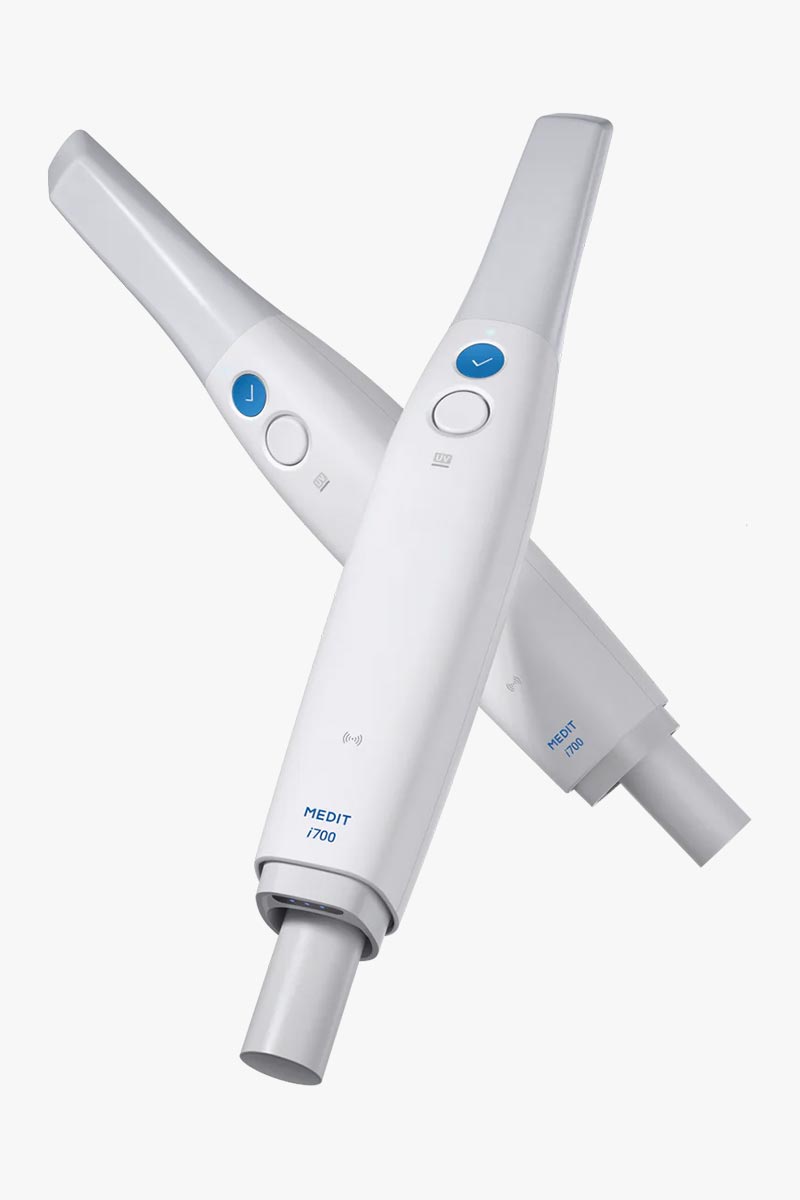
Intraoral Scanner
The intraoral scanner is an advanced technological tool used in dentistry to capture 3D digital images of the patient’s oral cavity.
Main functions and benefits:
- Accurately captures dental and gingival anatomy in high resolution, resulting in highly detailed digital impressions — eliminating the need for traditional physical molds, which can be uncomfortable for the patient and sometimes cause gag reflex.
- Fast scanning process, significantly reducing the time required to capture the patient’s mouth images.
- Digital images can be sent directly to the dental laboratory, allowing for the creation of prostheses, crowns, aligners, and other dental devices faster and more accurately, reducing patient waiting times.
- Useful for complex procedures such as dental implants, orthodontics, and oral rehabilitation.
- Enables dentists to monitor treatment progress over time by easily comparing changes in dental and gingival structures.
In summary, the intraoral scanner is an innovative tool that improves precision, efficiency, and comfort in dental procedures, benefiting both oral health professionals and patients.

Endodontic Microscope
For root canal treatments, we use an endodontic microscope. This provides significant magnification of the working area, offering a detailed view of root canals, fractures, cracks, and other internal tooth structures that are difficult to see with the naked eye.
Magnification and intense illumination allow the dentist to perform procedures with greater precision — essential for cleaning and shaping root canals, removing broken instruments, and locating additional canals.
The microscope also enables a more conservative approach, preserving as much healthy tooth structure as possible.
In short, the endodontic microscope is an indispensable tool for improving the quality of endodontic treatments, increasing precision, safety, and overall success.

Laboratory Centrifuge for L-PRF
To promote tissue regeneration, we use the L-PRF technique. It involves collecting a sample of the patient’s blood, which is then centrifuged to separate its components.
The result is a fibrin matrix rich in leukocytes and platelets, applied to the treatment area.
Main features:
- Minimises risk of rejection
- Speeds up healing
- Prevents infections

3D Computed Tomography (CBCT)
For imaging, Medidental uses high-resolution 3D technology, essential for detecting specific details in the patient’s mouth that are often missed in traditional 2D exams.
This diagnostic method is quick, painless, 100% safe, and allows immediate image analysis after the scan. Unlike other systems, it also drastically reduces the radiation dose the patient is exposed to.

Intraoral Camera
The intraoral camera is an invaluable tool for detecting and diagnosing numerous oral problems.
At Medidental, we believe it’s important for patients to literally see the condition of their mouth to better understand their real issues. It also allows us to record reliable “before, during, and after” images for oral rehabilitation procedures.

Intraoral Sensor
At Medidental, our professionals use digital X-ray sensors rather than traditional film.
Advantages:
– Lower radiation exposure for the patient
– Higher image quality for more accurate diagnoses

Apex Locator
The apex locator is used in endodontics to determine the position of the apical constriction (the narrowest part of the root canal).
It has also proven to be more efficient than radiography in locating the apical foramen (the largest opening of the root canal).

Prophy Jet
The Prophy Jet uses a jet of air, powder, and water to clean stains from the tooth surface.
Ideal for patients who smoke or consume coffee, tea, and other pigmented beverages.

Endodontic Motor
For root canal treatments, our clinic uses mechanised endodontics — a method developed to facilitate the process and reduce treatment time.
Advantages:
- Better canal preparation
- Maintains the canal’s original shape
- Greater comfort for both patient and dentist
- Shorter working time
- Reduced contamination between sessions

Sterilisation Equipment
Medidental uses the most advanced and rigorous sterilisation equipment, namely Class B autoclaves, regulated under the strictest standard set by European Norm EN 13060:2004.
This top-tier technology uses a vacuum pump to remove air from the sterilisation chamber, allowing hot steam to reach all internal and external areas of the instruments. Class B autoclaves can sterilise all types of solid, hollow, and porous instruments (packaged or unpackaged) with efficient steam penetration and high sterilisation performance.

Zirconia
At Medidental, we use zirconia because:
- Zirconia crowns and bridges closely resemble natural teeth, making it extremely difficult to tell them apart.
- As a very strong material, zirconia withstands daily wear and is highly durable.
- Like natural teeth, zirconia reflects light naturally (unlike some metal-based materials), making it especially suitable for front teeth and cases where the crown will be next to natural teeth.
- Zirconia crowns, made from strong ceramic, do not corrode and do not cause the typical dark gum line often seen around other crowns.
- As zirconia is not electrically conductive, it eliminates the “hot/cold” sensitivity sometimes experienced with other crowns.